


Garage Epoxy Flooring in Wilson Groves, FL
Garage Floors That Actually Last in Florida
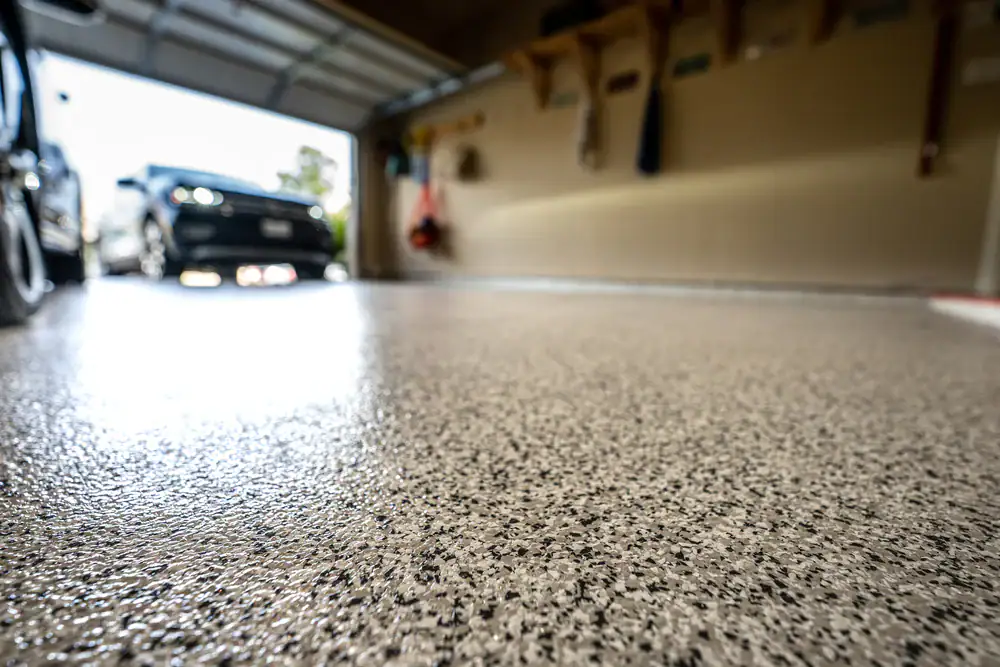
Hear from Our Customers
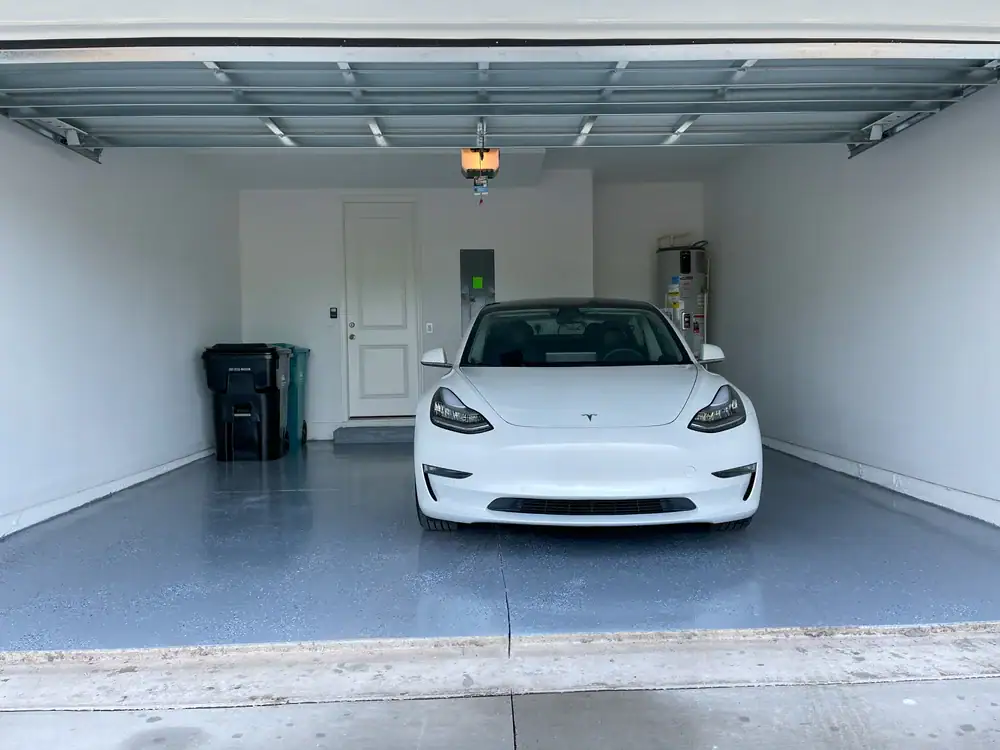
Professional Epoxy Garage Floor Installation
You’re tired of looking at that stained, cracked concrete. The oil spots that won’t come out. The surface that’s deteriorating faster than it should because of the humidity and heat.
Here’s what changes when the floor is done right. You pull in after work and the garage actually looks clean. Oil drips wipe up in seconds instead of soaking in permanently. The surface stays intact through summer storms, hot tires, and that 74% year-round humidity that destroys most coatings.
Your garage becomes usable space again. Not just somewhere to park, but somewhere you’d actually want to spend time. And when you eventually sell, you’re looking at a 5-10% bump in home value—buyers notice finished garages, especially in Florida where so many are falling apart.
The floor protects itself. It resists chemicals, won’t crack under vehicle weight, and doesn’t need special cleaning products or constant maintenance. Sweep it occasionally, mop when needed. That’s it.
Epoxy Flooring Contractors in Wilson Groves
SPF Industrial has been installing epoxy and polished concrete systems since 2020. We work directly with property owners in Wilson Groves and across Florida—both residential and commercial.
Our client list includes the Coast Guard, US Army, City of Doral, City of Sunny Isles, and multiple county facilities. These aren’t clients who tolerate mediocre work or shortcuts. When a municipal building or military installation needs flooring that performs under heavy use and harsh conditions, they call us.
We use Sherwin Williams and Fosroc products exclusively. Not because they’re cheaper—they’re not—but because they hold up to Florida’s climate when installed correctly. We handle surface prep, moisture mitigation, and application with the same attention to detail whether it’s a two-car garage in Wilson Groves or a 10,000-square-foot commercial space.
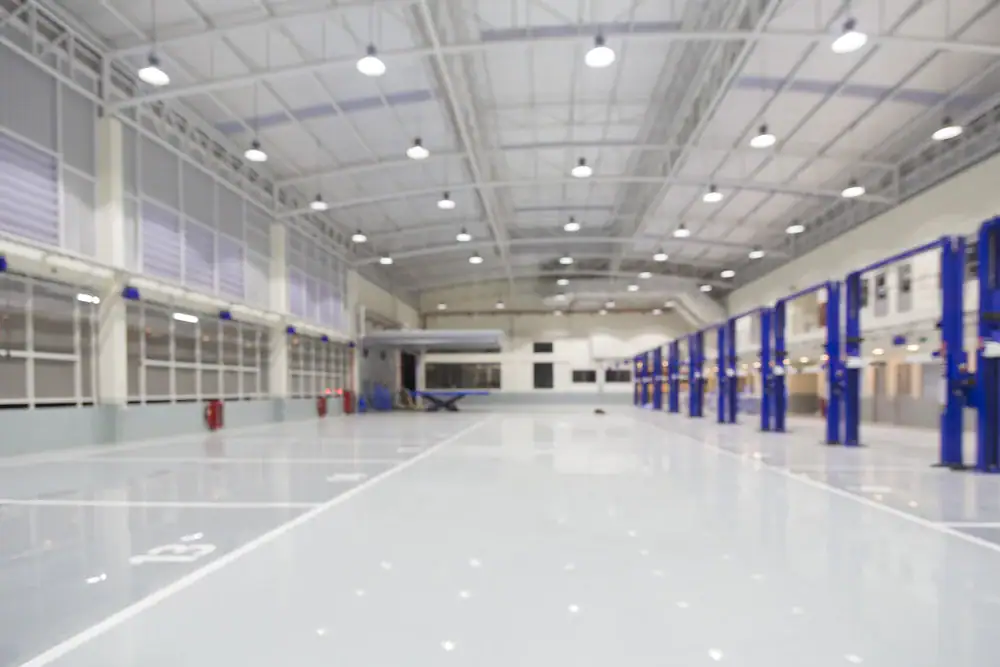
Garage Floor Coating Installation Process
First, we assess your concrete. Not every slab is ready for epoxy, and Florida’s humidity creates specific challenges. We test for moisture issues because that’s the number one reason coatings fail here—trapped vapor pushes up with 300 psi of force and lifts the epoxy right off.
Surface preparation comes next. This step determines whether your floor lasts two years or twenty. We grind the concrete to open the pores, remove any existing coatings or contaminants, and create the profile needed for proper adhesion. Most DIY failures and cheap contractor jobs fail because this step gets rushed.
Then we apply a moisture-tolerant primer designed for Florida conditions. This isn’t optional in our climate—it’s the barrier between your concrete and the humidity trying to destroy the bond. After that comes the high-solids epoxy base coat, followed by decorative flakes if you want them, and finally a clear topcoat that provides UV resistance and chemical protection.
The entire process typically takes two to three days depending on your garage size. You’ll need to keep vehicles off it during curing, but after that, you’re looking at 15-20 years of performance.
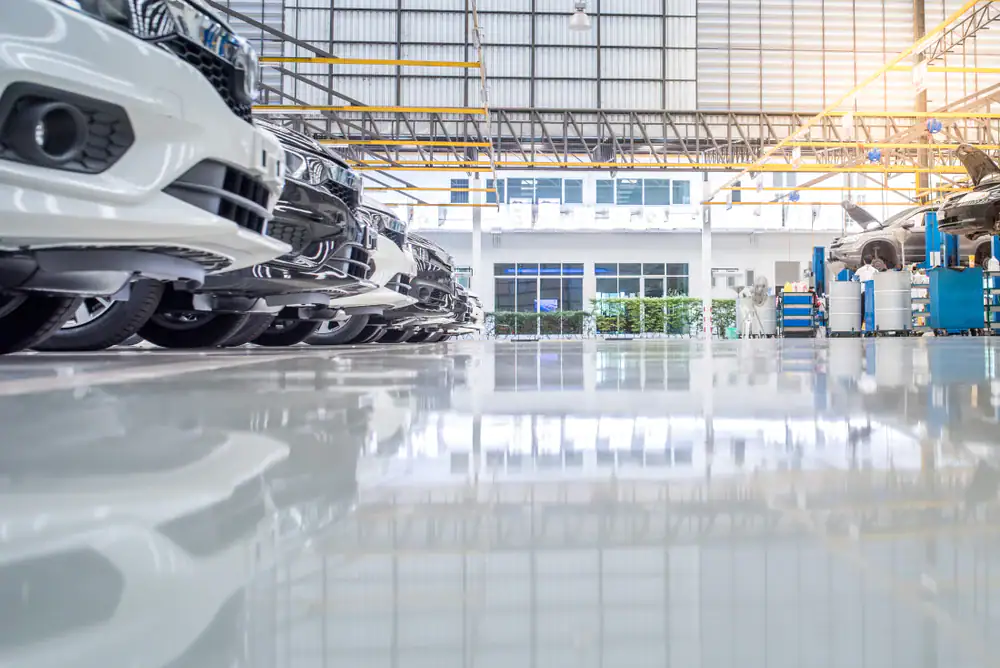
Ready to get started?
Garage Epoxy Floor Coating Options
You get a complete system, not just a coating slapped over concrete. That means moisture testing, surface grinding, crack repair if needed, and a multi-layer application designed specifically for Florida’s climate.
The base system includes moisture-tolerant primer, high-solids epoxy, and a protective topcoat. You can add decorative flakes in various colors—they’re not just aesthetic, they also improve traction when the floor gets wet. We also offer anti-slip additives if your garage sees a lot of water tracked in during Florida’s afternoon storms.
In Wilson Groves and surrounding areas, we’re seeing more homeowners opt for polyaspartic topcoats instead of standard epoxy clear coats. They cure faster, resist UV yellowing better, and handle hot tire pickup—that’s when your car’s hot tires literally pull the coating off the floor. It’s a common problem here that most people don’t know about until it happens.
The installation includes surface prep, all materials, labor, and a consultation where we walk through your specific garage conditions. We’re also available for emergency response if you have a commercial space that needs rapid turnaround—we’ve completed kitchen floors in 24-48 hours when timing was critical.
How much does epoxy garage flooring cost in Wilson Groves?
A professionally installed epoxy garage floor typically runs between $3 and $12 per square foot depending on the system you choose and your garage’s condition. A standard two-car garage (400-500 square feet) usually falls in the $1,500 to $4,000 range.
That’s not cheap, and we’re not going to pretend it is. But here’s the context: a DIY epoxy kit from a big box store costs $200-500 and has a 70% chance of failing within three years in Florida’s climate. You’ll end up paying someone to remove the failed coating and do it right anyway.
The cost covers moisture testing, diamond grinding the concrete, crack repair, primer, epoxy base, decorative flakes, and topcoat. In Florida, the surface prep and moisture mitigation are what you’re really paying for—that’s what separates a floor that lasts from one that bubbles and peels. We give transparent pricing during the consultation so you know exactly what you’re getting.
Will epoxy flooring hold up to Florida’s humidity?
It will if it’s installed correctly with the right products. If it’s not, Florida’s humidity will destroy it.
Here’s what happens: concrete is porous and Florida’s groundwater creates constant vapor pressure pushing up through your garage slab. Standard epoxy creates an airtight seal. When moisture gets trapped underneath, it builds pressure—up to 300 psi—and literally lifts the coating off the concrete. You’ll see bubbles, peeling, and delamination.
We handle this with moisture-tolerant primers and high-solids epoxy systems designed for humid climates. We also test your slab’s moisture levels before installation. If the readings are too high, we address that first. Southwest Florida data shows 72% of garage surfaces show wear from humidity and salt air within five years—but that’s mostly DIY jobs and contractors who skip the moisture mitigation steps. A properly installed system lasts 15-20 years even in Florida’s climate.
How long does garage floor coating installation take?
Most residential garage floors take two to three days from start to finish. Day one is surface prep—grinding, cleaning, repairs. Day two is primer and base coat application. Day three is topcoat and finishing.
You’ll need to keep vehicles and heavy items off the floor during this time. The coating needs to cure properly, and that timeline can’t be rushed without compromising the bond. Some contractors offer “one-day” epoxy installations, but those typically use faster-curing products that don’t perform as well long-term in Florida’s heat and humidity.
After installation, you can walk on the floor within 24 hours. But you should wait at least 72 hours before parking vehicles on it, and a full week before exposing it to heavy loads or chemical spills. The coating continues curing for about 30 days, reaching full hardness and chemical resistance during that time. We can offer faster turnaround for commercial spaces with emergency needs—we’ve done kitchen floors in 24-48 hours when timing was critical.
What’s the difference between DIY epoxy kits and professional installation?
DIY kits fail more than 70% of the time within 18-36 months in Florida. Professional installations last 15-20 years. The difference is surface preparation, moisture management, and product quality.
Box store epoxy kits give you a coating and basic instructions. They don’t include moisture testing, proper surface grinding equipment, or primers designed for Florida’s humidity. Most homeowners don’t know their concrete needs to be ground to a specific profile for proper adhesion. They don’t know about vapor pressure or hot tire pickup. So they clean the floor, roll on the epoxy, and it looks great for six months. Then it starts bubbling and peeling.
Professional installation means diamond grinding the concrete, testing for moisture issues, applying moisture-tolerant primers, using high-solids commercial-grade epoxy, and finishing with UV-resistant topcoats. We’re using the same products we install for military bases and municipal buildings—systems designed to handle heavy use and harsh conditions. The equipment alone costs tens of thousands of dollars. You’re not getting that level of prep with a $300 DIY kit.
Does epoxy garage flooring increase home value?
Yes. Homes with professionally finished garage floors typically see a 5-10% increase in resale value, and buyers aged 25-40 actively pay premiums for properties with completed garages.
Here’s why it matters in Wilson Groves and the broader Florida market: garages are visible, they’re part of the first impression, and most of them look terrible. Stained concrete, cracks, deterioration from humidity. When a buyer sees a clean, finished garage floor, it signals that the home has been maintained. It’s one of those upgrades that looks expensive but isn’t compared to kitchen or bathroom remodels.
The ROI is immediate in the sense that you get to use and enjoy the space while you live there, and you recoup most or all of the cost when you sell. It’s also one of the few upgrades where the cost-per-square-foot is relatively low compared to the perceived value increase. A $3,000 garage floor upgrade on a $350,000 home can add $15,000-35,000 to the sale price if it helps your property stand out in a competitive market.
Can you install epoxy flooring over existing garage floor coatings?
Sometimes, but usually it’s better to remove the old coating first. If there’s already paint, sealer, or failed epoxy on your garage floor, we need to assess its condition before deciding.
If the existing coating is peeling, bubbling, or poorly bonded, it has to come off. You can’t build a durable floor on top of a failing one—the new epoxy will only be as strong as whatever’s underneath it. We use grinders to remove old coatings down to bare concrete, then start fresh with proper prep.
If the existing coating is still fully adhered and in good shape, we can sometimes rough it up and coat over it. But that’s rare in Florida. Most existing garage coatings we see are already compromised by humidity, hot tire pickup, or poor initial installation. It’s frustrating to hear after you’ve already spent money on a previous coating, but removing it and doing it right is cheaper than coating over it and watching the whole system fail in a year.
Other Services we provide in Wilson Groves
Leave a Reply